
  |
Here are a few of the
pictures Nikki and I shot during our dives. These were
all taken using a Sea and Sea MX-10 camera with YS40
strobe and represent our first attempts at underwater
photography. I've captioned the pictures based upon
information in the "Snorkeling Guide to Marine Life
- Florida, Caribbean, Bahamas" but I'm not entirely
sure that some of the captions are correct. If you see
anything wrong, please let me know. I suppose I should really come clean on what I did to these pictures between picking up the prints from the lab and putting them on the site. They were all scanned into Adobe Photoshop 5.0 from 6"x4" prints using my UMAX 1200S scanner. Inside Photoshop, I cropped the images (a couple of these images represent areas as small as 25% of the original print) and resized them to the dimensions you see here. In most cases a slight "unsharp mask" filter was applied and in even fewer I admit that I added a bit of red to get the colour balance back to something like normal. I also tweaked the levels in some to get the contrast range looking a bit better. On the whole though, the scans you see here are pretty close to the original prints. (Yes, the Moray Eel picture was taken by Nikki) |
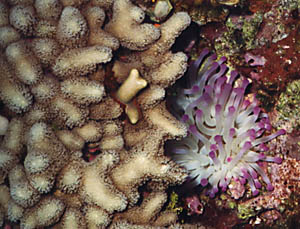 Finger Coral and Giant Anemone |
||
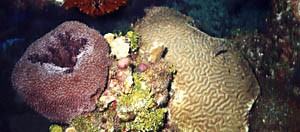 Brain Coral and Black Ball Sponge |
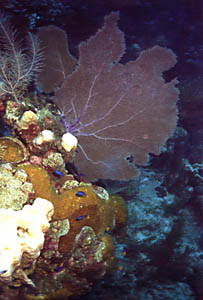 Common Sea Fan and Blue Chromis |
|
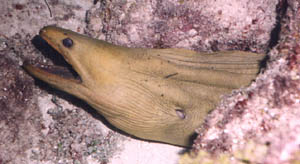 Green Moray Eel |
||
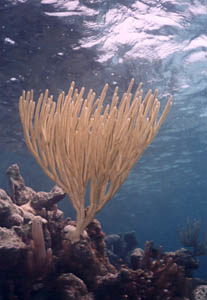 Porous Sea Rod |
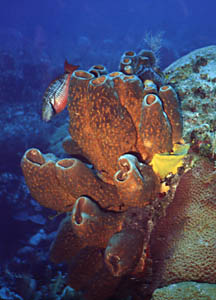 Stoplight Parrot Fish and Brown Clustered Tube Sponge |
|
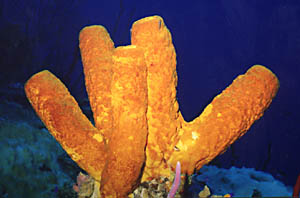 Yellow Tube Sponge |
||
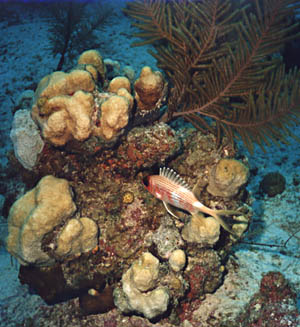 Squirrelfish |
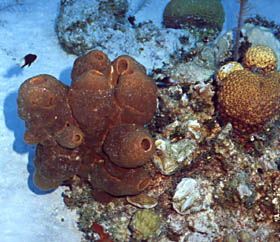 Brown Clustered Tube Sponge with a Bicolor Damselfish in the background. |
|
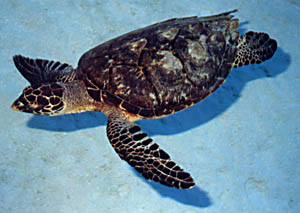 Green Sea Turtle |
Although I've been a keen photographer for years, this was my first attempt at underwater photography. Experts are encouraged to scoff at the following (or drop me email with corrections and suggestions) which are probably extremely obvious to anyone who has done this before but here are some things I learned about taking pictures above and below the surface with a Sea and Sea MX-10 camera, a YS40 strobe and no manual or textbook to read.
Using 100ASA film, don't bother trying to shoot anything that's closer than 2 feet or further than 4 feet away. The depth of field when underwater appears only to cover this distance and the external strobe and an aperture of f4.5 gives reasonable exposures in this range.
The folks at Fisheye load the cameras with 100ASA film and suggest using f8 as your basic aperture setting for a 3ft camera to subject distance. From my experience, this looks about 2 stops underexposed. I would strongly recommend using higher speed film to let you extend the depth of field by stopping down. I get the feeling that 400ASA at f4.5 for buddy-distance shots and f8 for closeups would probably be pretty good and I will try this next time I get a chance.
Stick to using print film for your first few attempts. The exposure latitude is a lot greater than transparency film and you should be able to get usable images even while experimenting with exposures this way.
Bubbles get in the way. Be careful of your breathing - depending upon your attitude in the water, your own bubbles may be flowing up over the lens of the camera obscuring your pictures.
Remember that the MX-10 is not an SLR so watch where your fingers are in relation to the lens (this is for the benefit of those of us who have used nothing but SLRs for years).
When you get out of the water, remember to dry the lens before taking pictures on the boat. The soft focus effect is interesting but not in every topside picture.
Above the surface, the depth of field is a lot better (I'm not sure if this is due entirely to the fact that you are generally stopped down a fair bit more on the surface or whether the refractive indices of air vs. water play a role here too) and you do get focus to infinity when at f8 or f11.
A photographer I talked to while there said that you should always try to shoot upwards to your subject (ie. shoot such that the water's surface is the background). If you are over a continuous reef, this gets pretty tricky but, on the shallow dives, there are often fingers of coral with sandy areas between them so you can drop onto the sand and shoot up from there towards the coral and the surface.
If you dive Tarpon Alley and see the school of fish sitting beautifully in one of the gulleys, don't get too excited about the pictures you are taking - all mine failed miserably despite bracketing across 3 stops. The closest fish was more than 4 feet away since I wanted to get the canyon sides into the picture too resulting in lack of focus and underexposure. Oh well....
Be surprised when you get your prints/slides back and see just how much red there actually is down there. Sponges that I thought were generally brown appear as vivid reds and oranges in the prints that I got correctly exposed (about 1 in 4 in my case, it seems)
Back to the Cayman Holiday Home Page
Back
to the Family Page